How to write a quote that wins the job
A great quote is clear, specific and easy to say yes to. It spells out exactly what the client gets, what it costs (including GST), what's not included, how long the price is valid and how to accept. Send it quickly, make it look professional, and follow up — that's how quotes turn into paid work.
Your quote is often the first real document a client sees from your business. A vague one-line price in an email invites haggling and scope creep. A clear, itemised quote builds trust, protects you if the job changes, and becomes the invoice once the work is done.
Key takeaways
- Send quotes fast — speed is often the difference between winning and losing the job.
- Itemise the work and list exclusions to prevent scope creep.
- Always show an expiry date and whether prices include GST.
- Include payment terms and any deposit upfront.
- Follow up after 2–3 days, and again before the quote expires.
What to include in a quote
| Section | What to show |
|---|---|
| Your details | Business name, ABN, phone, email and logo. |
| Client details | Name, business (if any), address or site address. |
| Quote number & date | A unique number (e.g. Q-0107) so you can match it to the invoice later. |
| Expiry date | “Valid until 30 November 2026” — not just “valid for 30 days”. |
| Scope of work | What you’ll do or supply, in plain English. |
| Exclusions & assumptions | What isn’t included and anything the price depends on. |
| Itemised prices | Line items with quantity, rate and amount. |
| GST & total | Subtotal, GST (if registered) and the total — be clear whether prices include GST. |
| Payment terms | Deposit, milestones and when the balance is due. |
| How to accept | Reply, sign, or click “Accept” — make it one easy step. |
How to write a quote, step by step
- Understand the job. Ask questions, visit the site or get a brief. Write down what the client actually wants to achieve.
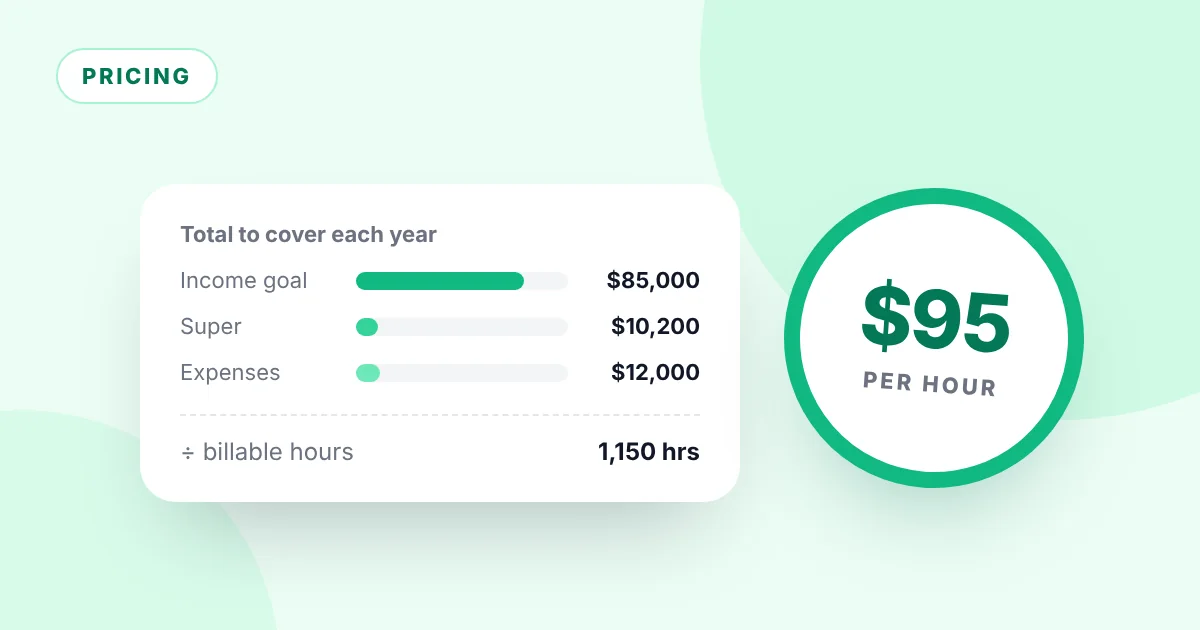
- Work out your costs. Materials, your time, subcontractors, travel, equipment hire — then add your margin. Our guide to how much to charge walks through the maths.
- Write the scope in plain English. “Supply and install 6 LED downlights in kitchen and living room” beats “lighting work”.
- List exclusions. “Excludes patching and painting” or “Includes two rounds of revisions” stops arguments later.
- Itemise and total it. Show quantities and rates. Add GST if you’re registered.
- Set terms. Expiry date, deposit, payment terms and how to accept. Need help with terms? See payment terms explained.
- Send it fast — ideally the same or next day — as a PDF or link, with a short, friendly email.
Free quote template
Copy this into your own document and fill in the brackets:
QUOTE
[Your Business Name] · ABN [00 000 000 000]
[Phone] · [Email] · [Website]

Quote number: Q-[0107]          Date: [23 October 2026]
Valid until: [22 November 2026]

Prepared for: [Client name] · [Client business] · [Address]

Scope of work
[Plain-English description of what you'll do or supply]

Item                              Qty    Rate        Amount
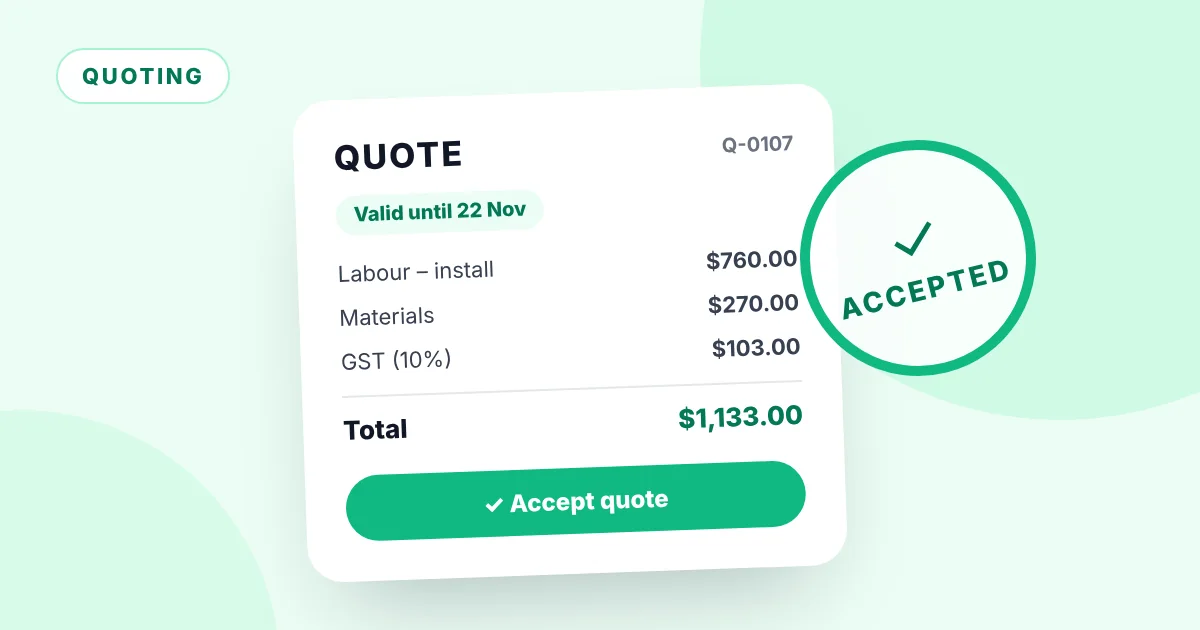
[Labour – installation]           [8]    [$95.00]    [$760.00]
[Materials – LED downlights]      [6]    [$45.00]    [$270.00]
                                         Subtotal    [$1,030.00]
                                         GST (10%)   [$103.00]
                                         TOTAL       [$1,133.00]

Not included: [e.g. patching, painting, after-hours work]
Assumptions: [e.g. clear access to the site, existing wiring is compliant]

Payment terms: [30%] deposit to confirm booking, balance due
within [7] days of completion.

To accept: reply "Accepted" to this email or sign below.
Signed: ____________________   Date: ___________
When the job’s done, turn it into an invoice with one of our free invoice templates — they use the same layout, so you can copy the line items straight across.
7 ways to win more quotes
- Be first. Clients often go with the first professional quote that lands.
- Look professional. A branded PDF with your logo beats a price in a text message. No logo? Make one with our free logo maker.
- Offer options. Good / better / best packages let clients choose how much to spend instead of whether to hire you.
- Sell the outcome. One line on the result (“a kitchen that’s bright and easy to clean”) helps more than another line of jargon.
- Show proof. Link a few photos of similar work, or a short testimonial.
- Make accepting easy. One click, one reply or one signature.
- Don’t race to the bottom. Explain what makes your price worth it rather than discounting straight away.
How to follow up on a quote
Most people don’t say no — they just get busy. A friendly nudge brings a surprising number of quotes back to life:
Subject: Your quote for [job] — any questions?

Hi [Name],

Just checking you received the quote for [job] I sent on [date].
Happy to talk through any of the details or adjust the scope to suit
your budget.

The quote is valid until [date] — let me know if you'd like to lock it in.

Thanks,
[Your name]
Send the first follow-up two or three days after the quote, and a final one a few days before it expires.
When the quote is accepted
- Confirm in writing — the scope, price, start date and deposit.
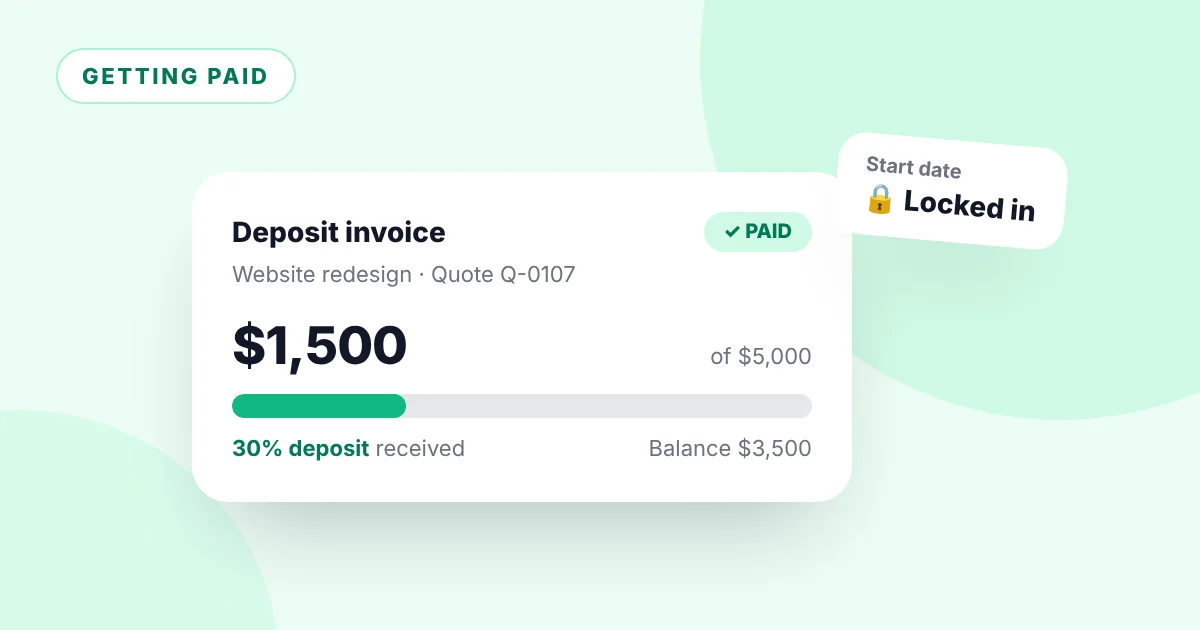
- Send a deposit invoice if you asked for one. Here’s how to ask for a deposit.
- Agree variations in writing. If the client asks for extra work, quote it separately before you do it. An accepted quote can form part of your contract — see quotes and estimates from the NT Government.
- Bigger jobs may need a proper contract. For example, in NSW, residential building work over $5,000 needs a written home building contract. business.gov.au explains how to prepare a contract.
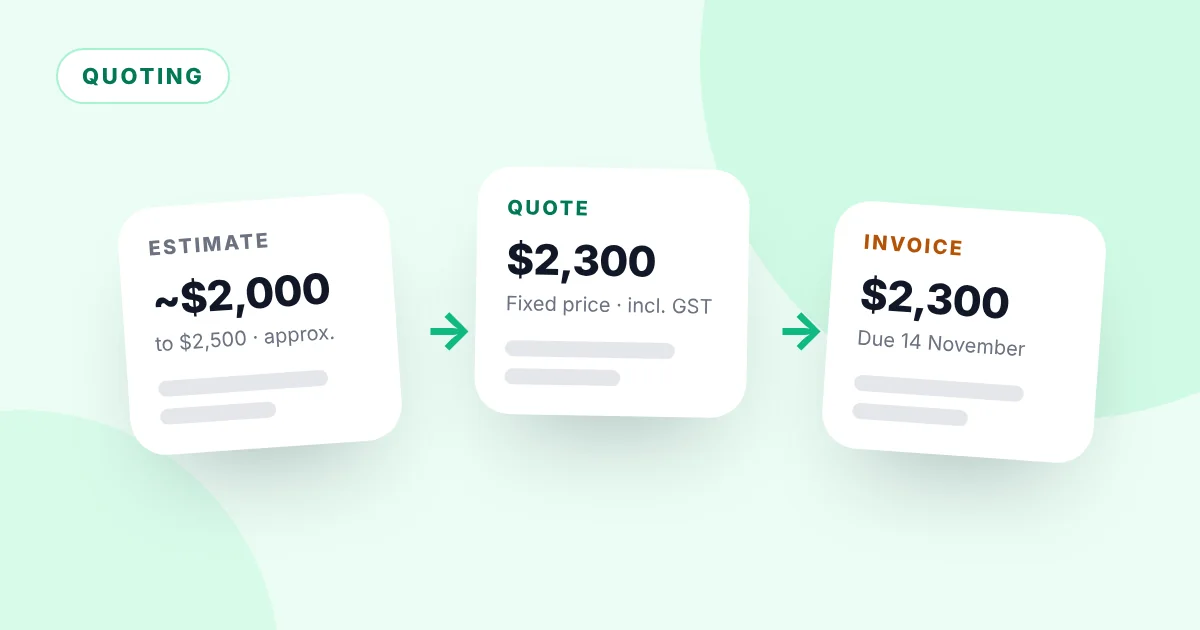
- Invoice promptly when the work is done, using the same quote number as a reference. Not sure of the difference between the two documents? Read quote vs estimate vs invoice.
Frequently asked questions
What should a quote include?
Your business name and ABN, the client's details, a quote number and date, an expiry date, a clear description of the work (including what's not included), itemised prices, GST, the total, payment terms such as any deposit, and how the client can accept.
How long should a quote be valid for?
There's no fixed rule. Many small businesses use 14 or 30 days. Choose a period that protects you from rising material or supplier costs, and print the exact expiry date on the quote.
Is a quote legally binding?
Once a client accepts your quote, it can form part of a contract — so you generally can't charge more for the same work without the client agreeing. Changes to the scope should be agreed in writing as a variation.
Should I charge for quotes?
Most small businesses quote for free to win work. For quotes that take significant time — such as site visits, detailed designs or complex jobs — some charge a quote fee and deduct it from the job if the client goes ahead. Tell the client upfront.
How soon should I follow up on a quote?
A short, friendly follow-up two to three days after sending, and another a few days before the quote expires, is a good rhythm. Ask if they have questions rather than pushing for a decision.
This article is general information only, not tax, legal or financial advice. Rules change — check the linked ATO and business.gov.au pages or speak to a registered tax agent about your situation.