How much should I charge? Setting your rates
To work out what to charge, add up the income you want (before tax), plus super and your business expenses, then divide by the hours you can actually bill in a year. That gives you your minimum hourly rate. Then check it against the market and the value you deliver — and don’t forget GST if you’re registered.
Undercharging is one of the most common mistakes new freelancers and sole traders make. It feels safe, but it means working longer for less — and it’s hard to climb out of later. Here’s a simple way to find a rate that actually pays the bills.
Key takeaways
- Minimum rate = (income goal + super + expenses) ÷ billable hours.
- You won’t bill 40 hours a week — plan for 20–30.
- Price for value, not just time, once you’re established.
- Be clear whether your prices include GST.
- Review your rates at least once a year.
The hourly rate formula
Minimum hourly rate =
(Income goal + Super + Business expenses) ÷ Billable hours per year- Income goal — what you want to earn before tax, as if it were a salary.
- Super — super isn’t compulsory for sole traders, but if you want to match an employee you’d add the 12% super guarantee rate. The ATO explains super for sole traders.
- Business expenses — software, insurance, phone, equipment, vehicle, accounting fees, training, marketing.
- Billable hours — the hours you can actually charge for, not the hours you work.
business.gov.au makes the same point: when you charge by the hour, your rate needs to cover all your business costs, not just your time.
A worked example
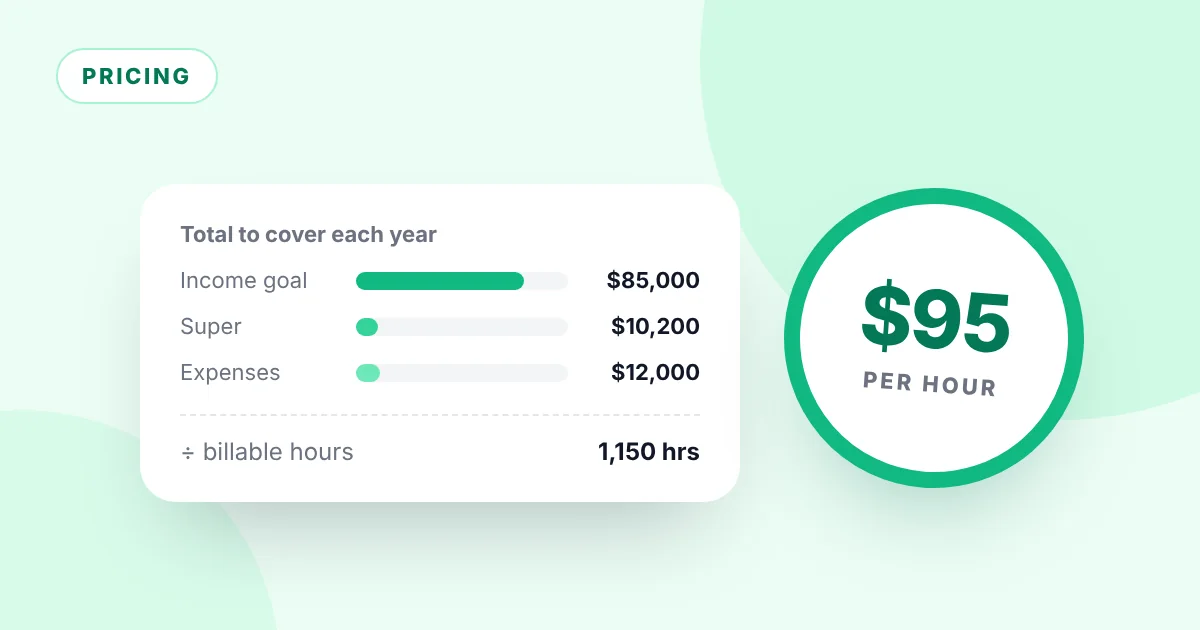
Say you’re a freelance designer who wants to earn the equivalent of an $85,000 salary:
| Item | Per year |
|---|---|
| Income goal (before tax) | $85,000 |
| Super (12%) | $10,200 |
| Business expenses | $12,000 |
| Total to cover | $107,200 |
Now the billable hours. Take 52 weeks, minus 4 weeks’ holiday and about 2 weeks for public holidays and sick days = 46 working weeks. You won’t bill every hour you work — quoting, admin, emails and marketing eat up time — so say 25 billable hours a week:
46 weeks × 25 hours = 1,150 billable hours

$107,200 ÷ 1,150 hours = $93.22 per hour  →  round up to $95/hour (ex GST)
That’s your floor — the minimum you need to hit your goal. Charge below it and you’re earning less than you planned. Add a profit margin on top for quiet months and growth.
Check it against the market
- Look at what similar businesses in your area and industry charge.
- Ask peers or your industry association.
- Consider your experience, speed, specialisation and reviews.
If the market rate is well above your floor — great, price closer to the market. If it’s below, you’ll need to cut costs, specialise, or find clients who value what you do differently. Don’t just match the cheapest competitor.
Hourly vs project vs value pricing
| Model | Best for | Watch out for |
|---|---|---|
| Hourly / day rate | Ongoing or unclear work, support, consulting | You earn less as you get faster |
| Fixed project price | Well-defined jobs — clients love certainty | Scope creep — list inclusions and exclusions |
| Value pricing | Work with a clear payoff for the client | Needs confidence and a good understanding of their goals |
| Packages / retainers | Repeatable services, monthly support | Define what’s included each month |
Even if you quote a fixed price, use your hourly rate behind the scenes: estimate the hours, multiply, add a buffer. Then present it as a clear, itemised quote — ideally with good / better / best options.
Pricing and GST
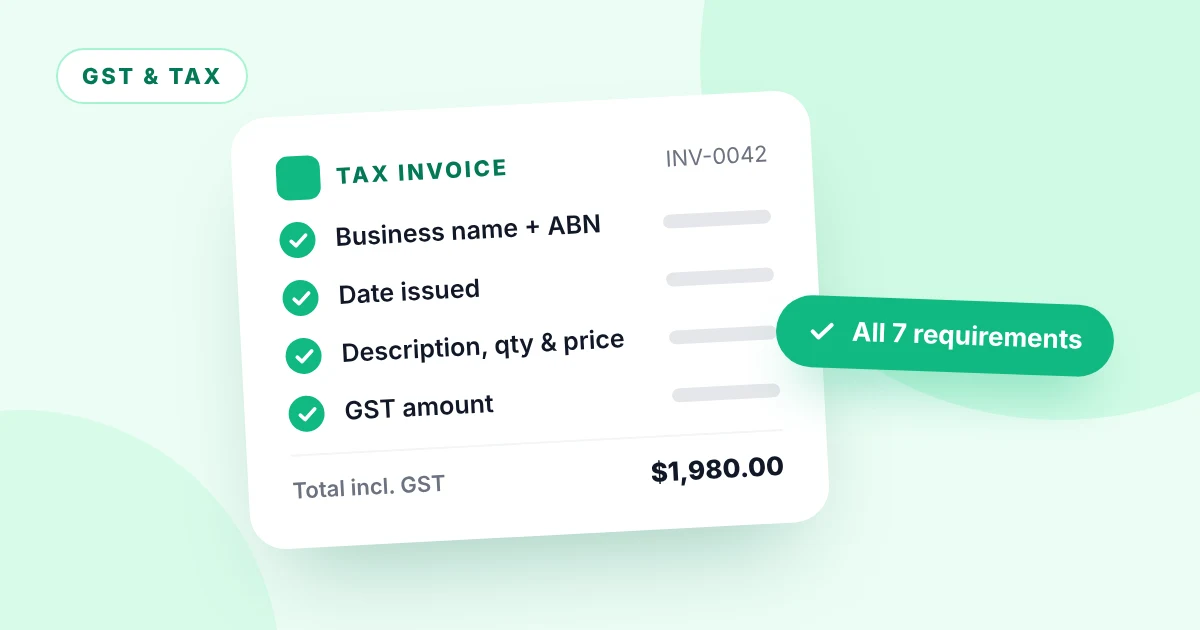
If you’re registered for GST, decide whether your prices are ex GST or GST-inclusive, and say so on every quote and invoice. Business clients usually expect ex-GST pricing; consumers expect the price they’ll actually pay. In the example above, $95/hour ex GST becomes $104.50 including GST. Use our free GST calculator to switch between the two.
Not sure if you need to register? Read do I need to charge GST?
How to raise your rates
- Review at least yearly, as business.gov.au recommends, or when your costs jump.
- New clients first. Quote new clients at your new rate straight away.
- Give existing clients notice — 30 days is common — and explain briefly.
- Keep it simple:
Hi [Name],

Thanks for another great year working together. From [1 January],
my rate will be [$110] per hour (ex GST). Anything booked before then
stays at the current rate.

Really appreciate your support — happy to chat if you have questions.

[Your name]
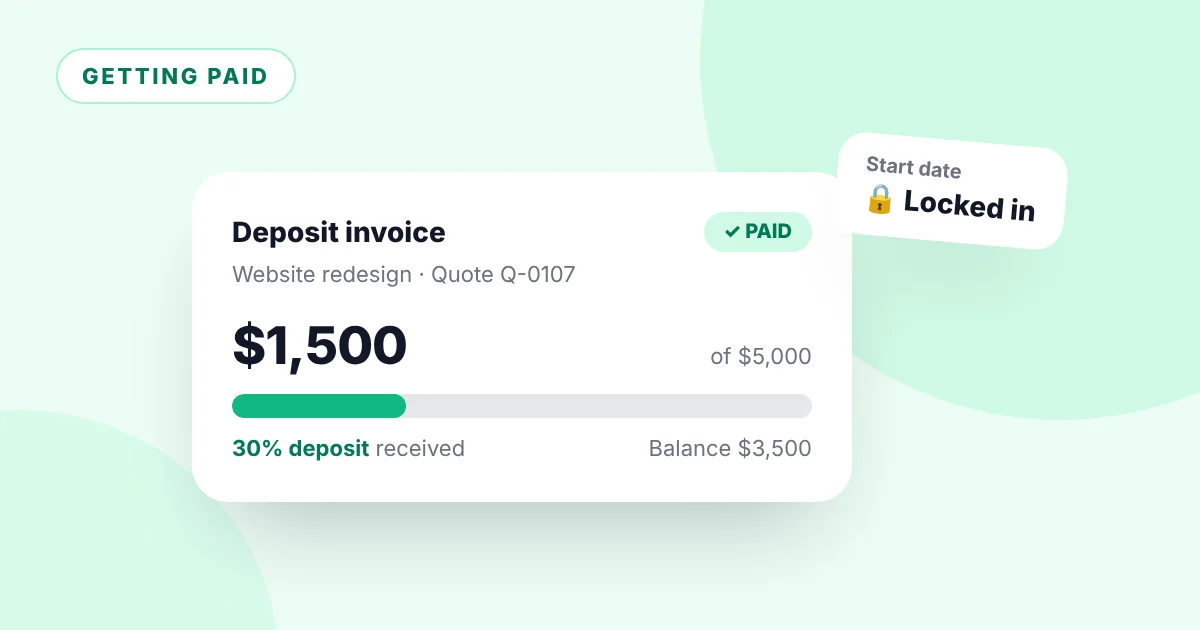
Once your rates are set, make sure you actually collect the money: set clear payment terms and ask for a deposit on bigger jobs.
Frequently asked questions
How do I calculate my hourly rate?
Add up the income you want to earn before tax, plus super and your yearly business expenses. Then divide by the number of hours you can realistically bill in a year. That's your minimum hourly rate before profit.
How many billable hours are there in a year?
Far fewer than you'd think. After holidays, sick days, admin, quoting and marketing, many freelancers bill somewhere around 20–30 hours a week for 44–46 weeks — roughly 900–1,400 hours a year.
Do sole traders have to pay themselves super?
No — super isn't compulsory for sole traders paying themselves, but it's worth building into your rate so you can contribute. The ATO explains super for sole traders and partnerships.
Should my rates include GST?
If you're registered for GST, be clear whether prices include it. Many businesses quote ex-GST to business clients and GST-inclusive to consumers. If you're not registered, don't add GST.
How often should I raise my rates?
business.gov.au suggests reviewing your prices at least once a year, or whenever your costs or the market change. Give existing clients notice before an increase.
This article is general information only, not tax, legal or financial advice. Rules change — check the linked ATO and business.gov.au pages or speak to a registered tax agent about your situation.